
In the context of modern projects in the construction, oil and gas, and infrastructure sectors, which are increasingly growing in scale and complexity, choosing a project control tool is no longer simply about selecting software, but about defining a management ecosystem. Oracle Primavera P6 has long been recognized as the global "gold standard," but businesses often face the dilemma between two versions: Professional Project Management (PPM) and Enterprise Project Portfolio Management (EPPM). From the perspective of a systems consultant, this article will delve into the core technical differences and strategic value each version offers to help businesses make the most informed investment decision.
Overview of the two versions of project management software
- Primavera P6 PPM (Professional Project Management)
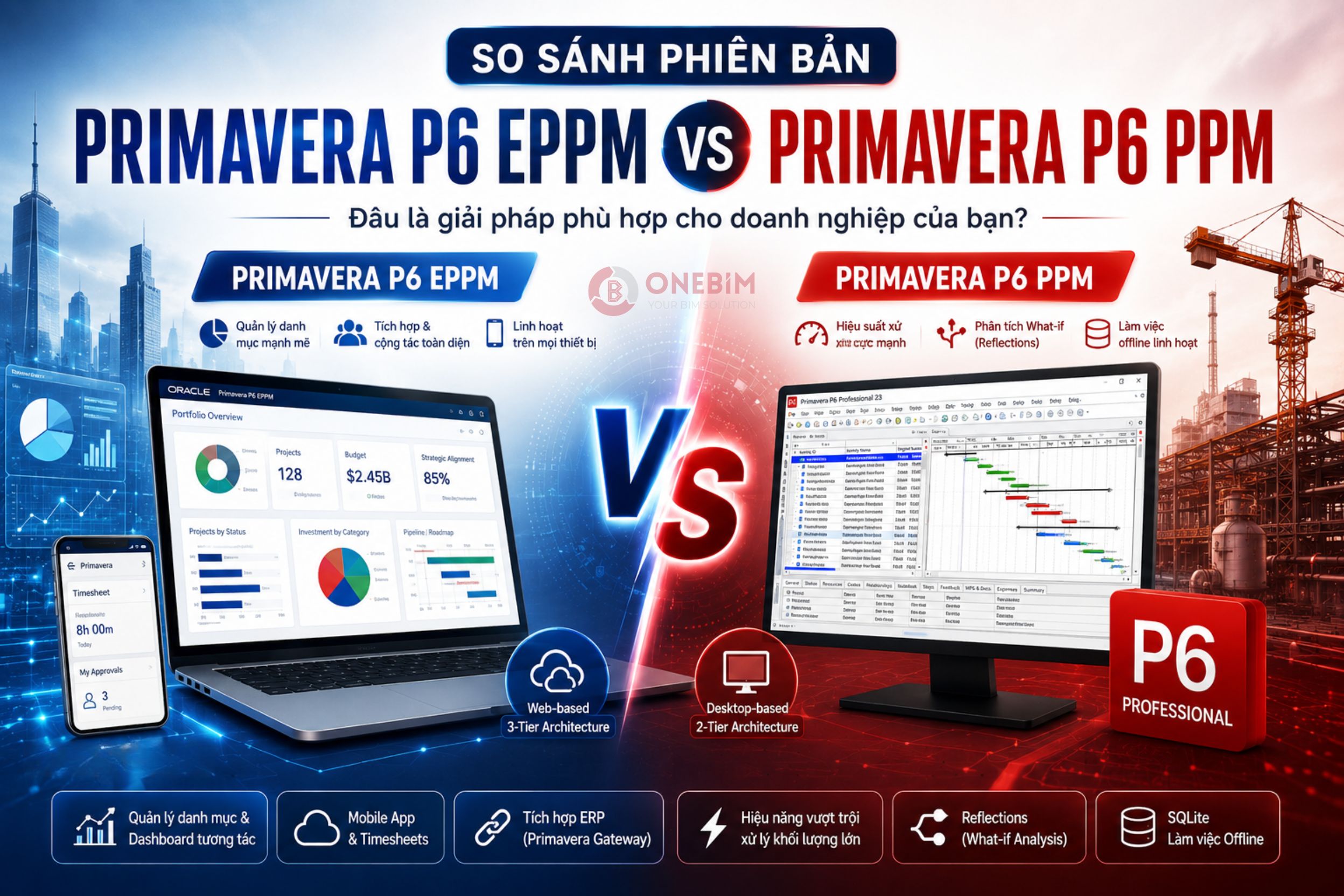
This is a planning tool for the Windows platform, designed for professional schedulers. Technically, PPM uses 2-tier architecture , where the client application installed on a PC connects directly to the database (Oracle, SQL Server, or SQLite for personal/offline use). PPM’s greatest strengths are its independence, instant responsiveness, and pure processing power.
2. Primavera P6 EPPM (Enterprise Project Portfolio Management)
EPPM is a project portfolio management solution based on a 100% web-based platform , using a three-tier (3-tier) architecture with a middle application server. However, one key point that is often overlooked is that EPPM is not just a web interface. When owning EPPM, enterprises are also granted access to the “Optional Client” – a desktop version similar to PPM but directly connected to the EPPM database. This allows EPPM to provide maximum flexibility: a web interface for management and a specialized desktop interface for schedulers.
Analyze the features
Architecture and Implementation
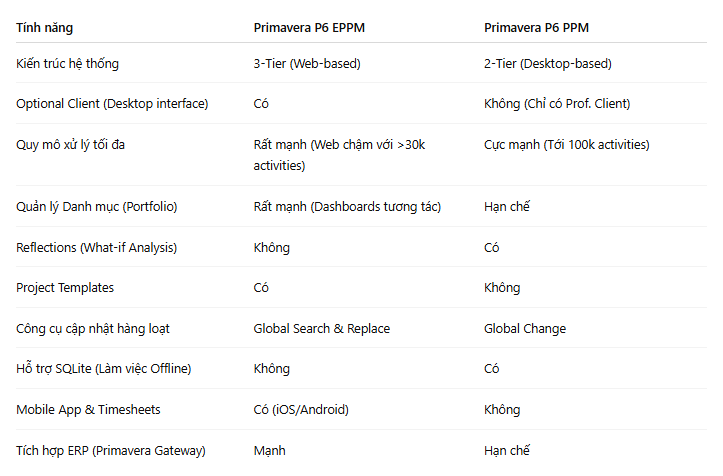
- PPM: Requires local software installation on each computer. PPM supports SQLite , allowing specialists to work completely offline and independently – an extremely important feature for construction sites in remote areas.
- EPPM: Centrally deployed on the server. User management becomes simpler through the web browser, but the server-side infrastructure is significantly more complex due to the need to configure BI Publisher, Analytics, and Primavera Gateway.
Performance and Scalability
- PPM: A “heavy-duty weapon” capable of smoothly handling projects with up to 100,000 activities thanks to direct processing on the computer’s hardware.
- EPPM (Web interface): Although highly powerful, the web interface can become slow and less responsive when handling large schedules (over 30,000 activities). In such cases, EPPM users often switch to the Optional Client to ensure optimal work performance.
Advanced Features and Specialized Tools
The biggest difference lies in the tools used for batch data processing and scenario analysis:
- Reflections (What-if Analysis): Available only in PPM . This feature allows users to create a copy of a project to test changes before applying them to the main schedule. EPPM does not support this feature, which is a significant limitation for Power Users.
- Global Change vs. Search & Replace: PPM features the extremely powerful Global Change tool for performing conditional bulk data updates. Meanwhile, EPPM uses the Global Search & Replace feature, which is somewhat more limited in comparison.
- Project Templates: EPPM stands out with its support for Project Templates , enabling users to quickly create new projects from standardized frameworks. In PPM, users must manually duplicate existing projects.
IT Management and Operational Risk
- EPPM is heavily dependent on Java. Managing different Java versions between user machines often causes conflicts and display errors (Java pop-ups), putting considerable pressure on the IT support department.
- PPM is more stable in terms of operating environment because it runs independently on the Windows Client, not dependent on Internet speed or browser configuration.
A comprehensive comparison table of key features.
Analyzing the advantages and disadvantages from an operational perspective.
Primavera P6 PPM
- Advantages:Instant response speed, stability, excellent offline performance with SQLite. The Global Change and Reflections tools are invaluable for in-depth scheduling professionals.
- Disadvantages:Difficulty in real-time collaboration between multiple departments. IT must install/update on each individual machine, making centralized management difficult when the number of users is large.
Primavera P6 EPPM
- Advantages:Excellent collaboration capabilities via Web and Mobile. Provides an intuitive dashboard for leaders. In particular, the “Hybrid” model (combining Optional Client for Schedulers and Web for Managers) delivers the highest management efficiency.
- Disadvantages:High deployment cost and server-side complexity. Dependent on Java and internet speed.
Which version should businesses choose?
The choice should not be based solely on features, but also on the company's mature governance model:
Businesses should choose Primavera P6 PPM when:
- Project Control teams are small in size, working independently or on a site-by-site basis.
- The requirement is to handle mega-projects with tens of thousands of tasks and to have "real-time" processing speeds on the desktop.
- Specialized features like Reflections are needed for claim analysis or Global Change for data cleaning.
Businesses should choose Primavera P6 EPPM when:
- As a large corporation, we need transparency and real-time data for our management team through dashboards.
- A centralized management system is needed, allowing field personnel to update progress via mobile devices or timesheets.
- Strategic Note:Leverage the EPPM license to implement a hybrid model. Scheduling specialists will use the Optional Client for the speed of PPM, while management uses the Web interface to monitor the portfolio. This is the optimal solution to leverage the power of both worlds.
Primavera P6 PPM remains the sharpest weapon for professional planners needing absolute power and stability. However, EPPM is the inevitable trend for businesses undergoing digital transformation, where collaboration and centralized data are key to success. Choosing the right version is the first step in building a sustainable and effective project management system.
FAQs
Which Primavera version should large enterprises choose?
Answer:
For a
large enterprise
,
Primavera P6 EPPM
(Enterprise Project Portfolio Management) or the
Oracle Primavera Cloud (OPC)
solution is generally a more optimal choice compared to the traditional PPM version.
If your enterprise has a
matrix organizational structure, large scale, multiple parallel-running projects, and requires close collaboration between field teams and office staff
, then
Primavera P6 EPPM
or
Oracle Primavera Cloud
is the most suitable solution to ensure transparency and effective project governance.
If an enterprise purchases a Primavera P6 EPPM license, can we use the PPM interface?
Answer:
Yes. When an enterprise purchases a Primavera P6 EPPM license, you will be provided with a tool called the “Optional Client.” This software allows users to access the EPPM database through a Windows desktop interface identical to the P6 PPM version
. This provides significant flexibility, allowing managers to work through the web interface while schedulers can continue using the desktop interface.
Does Primavera P6 EPPM support progress updates from construction sites?
Answer:
Yes. Primavera P6 EPPM is designed with built-in collaboration tools such as
P6 Team Member Web
and mobile applications (
P6 Mobile/Apps
) that support both Android and iOS.
Field team members can easily use their smartphones to update work progress or submit timesheets anytime and anywhere
. This feature is not available in P6 PPM.